How to Set Up a Clothing Micro Factory For Your Brand

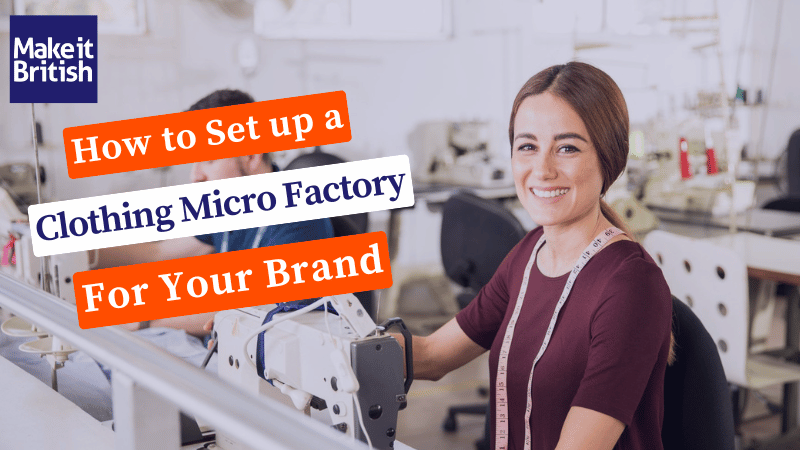
Thinking about setting up your own clothing micro factory?
Running your own in-house production unit – what I call a clothing micro factory – can transform your business. You gain flexibility, you save costs, and you respond faster to your customers. Even Vogue agrees that micro factories are the answer to making fashion on demand.
For many small brands it’s not about struggling to find a manufacturer. It’s about choosing to bring production in house because it makes better business sense.
I learnt this first-hand when I started out.
How I set up my own clothing micro factory
When I left college in the early 1990s I began making garments from vintage blankets and curtains on my domestic sewing machine. They sold well on a Camden Market stall.
Demand quickly outstripped what I could produce at home. Instead of outsourcing, I bought an industrial sewing machine for a few hundred pounds, hired a machinist, and within months I had a small clothing micro factory in Shoreditch.
That decision gave me control over quality and speed, and meant I could grow at my own pace. It’s an option many small brands overlook today.

7 benefits of running your own clothing micro factory
- Control over quality and timing
You set the standards. You choose when production happens. No waiting for another factory’s slot or compromising on finish. - Faster lead times
You can restock or launch a new product as soon as you need it. In-house production lets you move at your customers’ pace. - Bespoke and customised products
Personalisation is a growing market. With your own set up you can offer custom fabrics, trims or details without relying on anyone else. - Full knowledge of your processes
You’ll understand every stage of production. This means accurate pricing, realistic timelines and no nasty surprises. - Lower overheads
You avoid paying a factory’s margin, overheads and profit. You only cover your own direct costs. - Make to order and avoid dead stock
You produce only what has been sold. This frees up cash, reduces storage costs and supports a more sustainable model. - Faster product development
Have an idea today? You can sample it tomorrow. A micro factory gives you speed to market and an edge over competitors.
How to start your own clothing micro factory
Bringing production in house doesn’t mean opening a huge factory. Many successful brands start small. Here’s how to approach it.
Assess your product
Choose items that are simple to produce with one or two types of machinery. Tote bags, T-shirts or cushions are ideal. More complex pieces like tailored jackets may be better outsourced at first.
Check your demand
Look at average monthly orders, seasonal peaks and best sellers. This helps you decide whether you need one machinist or more. Start lean and grow steadily.
Choose your space
Your first micro factory could be a spare room, a shared studio or a small industrial unit. Look for good lighting, ventilation and power supply. Many councils have affordable starter units for makers.
Equip your micro factory
At a minimum you will need:
- An industrial straight stitch sewing machine (£500–£1,500)
- An overlocker for garments (£800–£2,000)
- A professional steam iron and vacuum board (£500 upwards)
- Cutting tools such as shears or a small cutting knife
Buy second-hand where possible. Many ex-factories and auction houses sell reliable kit at a fraction of the price.
Hire or train help
Even one part-time machinist can double your capacity. Many skilled workers in the UK prefer flexible hours. If you can’t find someone, consider training. Organisations like Fashion Enter offer machinist training for new staff.
Map your process
Document each stage from cutting to packing. Time every step and cost it out. A simple spreadsheet is enough at first. This gives you a true cost per unit and supports proper pricing.
Scale steadily
Add more machines or staff only when sales justify it. Many strong UK businesses — such as Community Clothing in Blackburn — grew steadily and built resilience by expanding step by step.
In-house micro factory vs outsourcing: a quick comparison
| Factor | Clothing micro factory | Outsourced production |
|---|---|---|
| Quality control | Direct oversight | Rely on factory standards |
| Lead times | Immediate, flexible | Wait for production slots |
| Costs | Pay only your own overheads | Pay factory margin and overheads |
| Stock risk | Make to order | Higher minimum orders |
| Innovation | Sample and test quickly | Development takes longer |
| Customisation | Easy to offer | Limited by factory willingness |
Examples of brands that have set up their own clothing micro factory
Usual Objections
Usual Objections, the London-based swimwear label, runs its entire production from a micro-factory in Hackney. Founders Rich and Linda handle everything – from sampling to printing – right under their one roof. This setup followed failed efforts with several UK manufacturers and taught them they could gain control, cut costs, and speed up production by taking everything in-house.
Emma Willis
Emma Willis, celebrated shirtmaker, chose to bring production close to home by setting up her own UK workshop in Gloucester. Built within a beautiful 18th-century townhouse, this micro factory allows Emma to oversee every aspect of quality control and craftsmanship. Her team hand-cut and hand-sew luxurious shirts in a well-lit, inspiring space, and in doing so, she preserved British tailoring traditions while maintaining a close-knit production ethos.
FAQs
It can be. You save on paying for another manufacturers overheads, but you’ll need to cover equipment, staff and space. But the flexibility of having your own production means many brands find it pays off in the long run.
Simple garments, accessories and homewares. Pieces needing expensive specialist machinery or many stages may be better outsourced.
Yes! That’s what i did. Then once sales grew it made sense to move to a larger.
That depends on what you are planning to make. Simple garments need just a couple of industrial machines.
Final thoughts
Setting up a clothing micro factory puts you in control. It gives you speed, flexibility and savings compared to outsourcing. If your product is suitable, starting small and scaling steadily could be the smartest investment you make in your brand.